
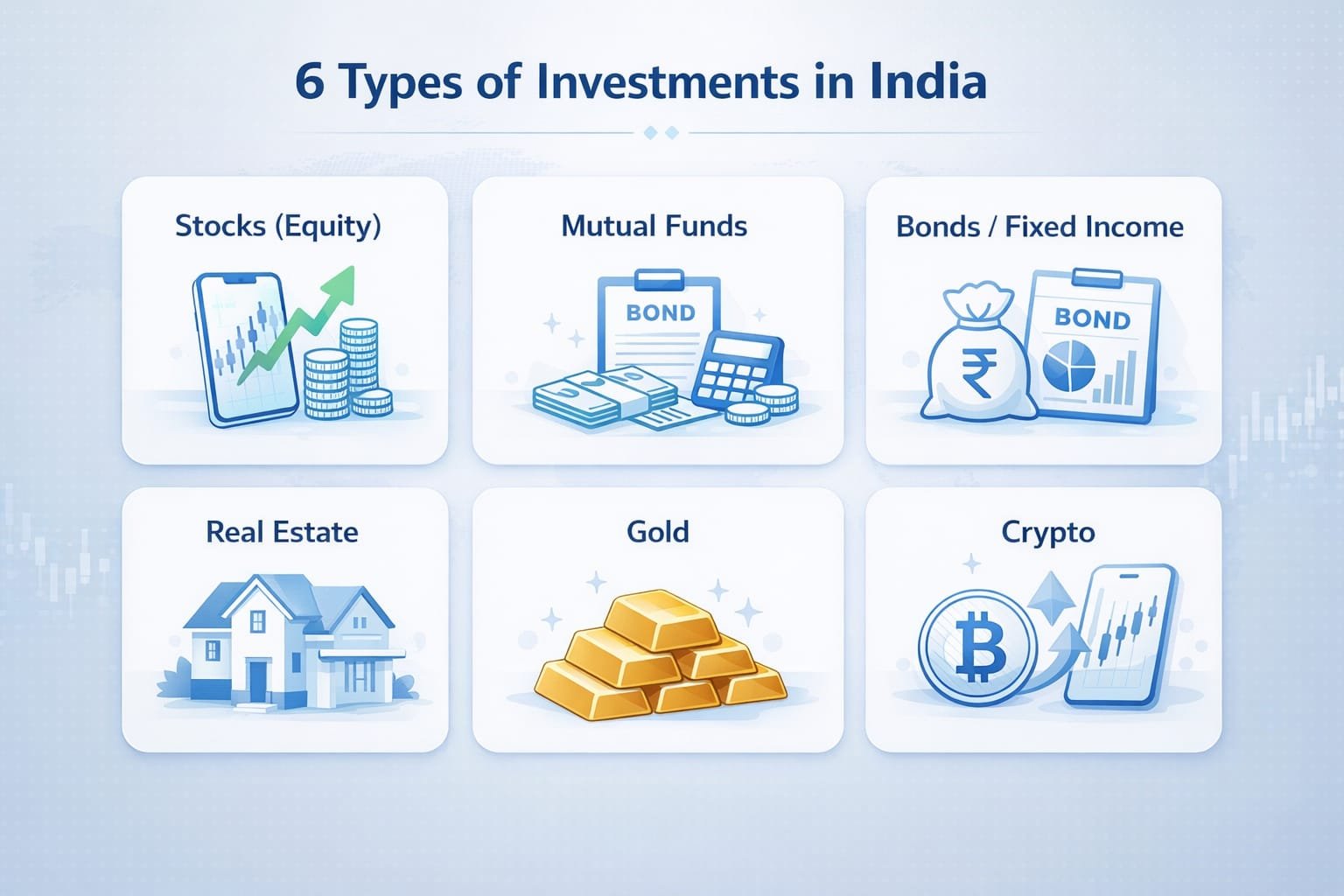
When people search for types of investments in India, they’re not just looking for definitions.
They’re trying to answer a much more practical question: Where should I actually invest my money?
India offers many options — stocks, mutual funds, bonds, real estate, gold, and crypto. But without understanding their role, most people either follow trends, act on tips, or stay confused.
This guide will break down each investment option — what it is, how it works, real examples, and where it fits.
Types of Investments in India
1. Stocks (Equity)
Stocks represent ownership in a business. When you buy a stock, you become a small owner in that company.
- How it works: If the company grows, your investment grows. If it struggles, stock prices may fall.
- Example: ₹10,000 invested in a strong company can grow multiple times over 10 years.
- Insight: Stocks reward patience, not short-term trading.
- Insight: Stocks reward patience, not short-term trading.
- Where it fits: Long-term wealth creation.
2. Bonds / Fixed Income
Bonds are loans you give to companies or the government in exchange for fixed returns.
- How it works: You earn regular interest and get your money back after maturity.
- Example: ₹1,00,000 at 7% gives ₹7,000 annually.
- Insight: Bonds provide stability, not high growth.
- Where it fits: Stability and low-risk investing.
3. Mutual Funds
Mutual funds pool money from multiple investors and invest on their behalf.
- How it works: A fund manager invests across stocks or bonds.
- Example: SIP of ₹5,000 monthly can build wealth over time.
- Insight: Mutual funds simplify investing but require discipline.
- Where it fits: Balanced growth and beginner-friendly investing.
4. Real Estate
Real estate involves investing in property such as land or flats.
- How it works: You earn through rental income and price appreciation.
- Example: Buying a flat and earning rent monthly.
- Insight: Requires large capital and patience.
- Where it fits: Long-term asset building.
5. Gold (Commodities)
Gold is a traditional store of value in India.
- How it works: It protects wealth during uncertain times.
- Example: During market crashes, gold often holds value.
- Insight: Gold is for protection, not growth.
- Where it fits: Portfolio stability.
6. Crypto
Crypto is a digital asset class with high volatility.
- How it works: Prices depend on demand and sentiment.
- Example: Can rise or fall sharply within short periods.
- Insight: High risk, high uncertainty.
- Where it fits: Small allocation only.
Simple Framework
Growth → Stocks / Equity Funds
Stability → Bonds / FD
Protection → Gold
Diversification → Mutual Funds
High Risk → Crypto
Example Portfolio (Beginner)
60% Equity (stocks/mutual funds)
20% Debt (FD/bonds)
10% Gold
10% Cash / optional
Final Thoughts
Investing is not about finding the best option, but using each option correctly.
FAQs
Which investment option is best in India?
There is no single “best” investment option. Each option serves a different purpose — stocks for growth, bonds for stability, gold for protection, and mutual funds for diversification. The key is understanding where each fits rather than choosing just one.
Is it better to invest in stocks directly or through mutual funds?
Both serve different needs. Stocks require understanding of businesses and long-term patience, while mutual funds simplify the process by managing investments on your behalf. The choice depends on your comfort with learning and managing investments.
Why is diversification important in investing?
Diversification helps balance risk by spreading money across different asset types like equity, debt, and gold. Since each asset behaves differently, diversification reduces the impact of market fluctuations on your overall portfolio.